
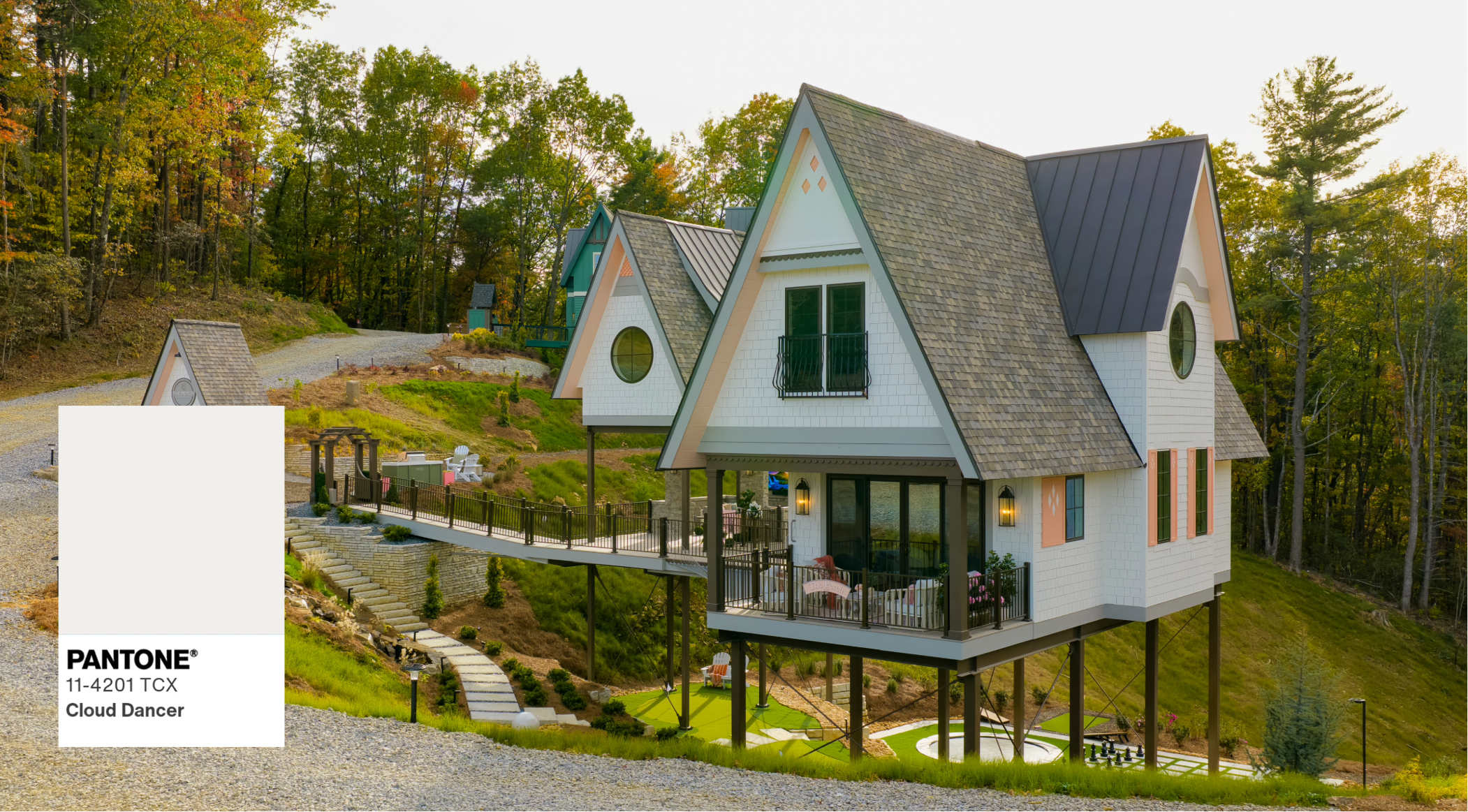
Pantone 2026 Color of the Year: Cloud Dancer (PANTONE 11-4201) — a serene, airy white chosen to evoke clarity, calm, and creative openness in a rapidly changing world.
Why Cloud Dancer Matters to the Built Environment
Pantone’s Cloud Dancer is notable not just for its aesthetic quality, but for what it symbolizes for design professionals:
- A Blank Canvas for Innovation: A neutral with purposeful nuance, this soft white isn’t stark or clinical — it offers spatial flexibility and visual harmony that supports both bold and subtle architectural expressions.
- Enhanced Perception of Space: In experiential design, lighter tones can amplify natural light, make environments feel larger, and emphasize volumetric form — essential in both residential and commercial spaces.
- Emotional Resonance: As designers continue to balance technology and human experience, calm palettes like Cloud Dancer reinforce tranquility and focus — attributes increasingly prized in living spaces and work environments.
This makes Cloud Dancer a powerful base tone — think walls, cladding, ceilings, or integrated elements — for projects where psychological comfort and architectural clarity are goals.
Case Study: The Perch — Treehouse Innovation in North Georgia
Located in the scenic Cohutta Wilderness near Atlanta, The Perch is part of a mountain retreat that marries imaginative design with structural ingenuity.
- Designed as elevated, multi-level treehouse structures connected by dramatic skybridges, these builds demonstrate how architecture can respond to context, not just occupy it.
- With bespoke engineering challenges due to topography and exposure, the emphasis on material performance, geometry, and environmental harmony aligns with cutting-edge practice.
Here’s why this project pairs naturally with Pantone’s vision:
Spatial Clarity Meets Structural Expression
Cloud Dancer’s captivating neutrality mirrors the serene forest canopy and sky — offering a visual bridge between architecture and the natural palette.
Design Flexibility
Against the backdrop of rich wood tones, textured stone, foliage, and shifting daylight, Cloud Dancer-infused elements can:
- Enhance contrast with natural materials
- Provide continuity across indoor-outdoor transitions
- Frame views without competing for attention
Supporting Human Experience
Whether rising above a mountain vista or nestled among trees, elevated living environments challenge the senses. Using a reflective, refined hue creates calm — reinforcing wellbeing while preserving the drama of place.
Design Insights: Applying Cloud Dancer in Real Projects
Here are practical takeaways for architects, engineers, and designers looking to leverage this color in 2026:
1. Neutral Backdrops, Bold Details
Use Cloud Dancer as a neutral scaffold that allows other design elements (fixtures, materials, accents) to take center stage — especially in complex architectural forms like those at The Perch.
2. Light & Shadow as Design Tools
In spaces with varied ceiling heights, rooflines, and structural carriers, Cloud Dancer can amplify natural light while softening transitions — helping create atmospheric depth and acoustic balance.
3. Harmonizing Contrasts
Whether you’re working with premium timber, structural steel, or rugged stone veneer, this balanced white supports high-contrast palettes without visual fatigue — ideal for sophisticated residential or hospitality interiors.
A 2026 Forecast: Calm, Clarity, and Creative Space
As architects and engineers push toward sustainable, human-centric design, palettes that reflect serenity and adaptability will play an increasingly prominent role. Pantone’s Cloud Dancer — a soft, thoughtful white — is positioned not just as a color, but as a design philosophy for the year ahead.
And projects like The Perch remind us that elegant restraint and structural excellence are not mutually exclusive — they’re complementary expressions of design ambition.
Explore more real-world examples like The Perch on our Pinterest page, where we highlight how material choice, site context, and now color forecasting can transform architectural outcomes.