
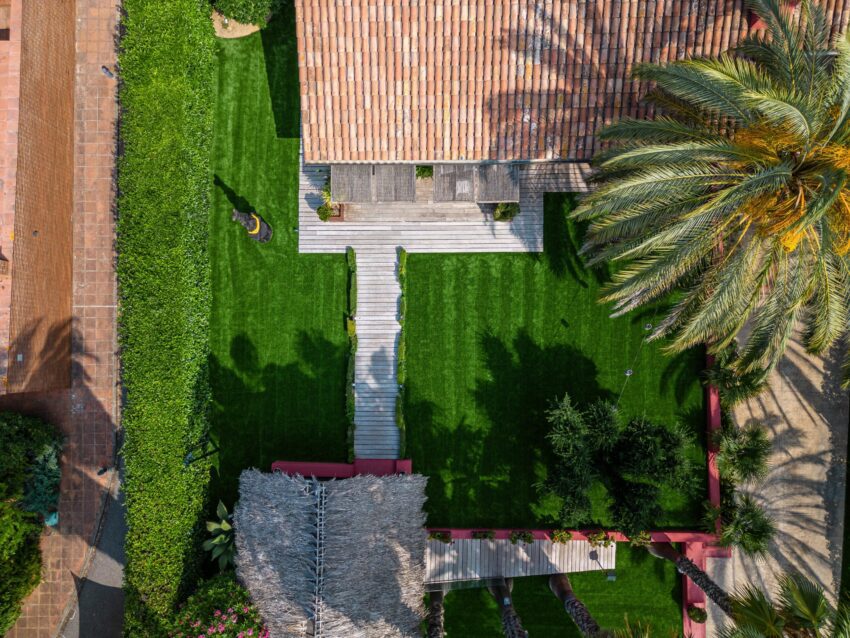
The grass is acting, too.
When people talk about great film and television production design, they usually talk about the hero house, the spaceship hallway, the fantasy village, the mansion pool deck, the reality TV villa, or the dramatic oil-country backdrop.
What they do not always notice is the ground.
But the camera notices.
Grass, turf, dirt, gravel, mud, mulch, and every surface under an actor’s boots can make a set feel believable or completely break the illusion. In movies, scripted television, commercials, and reality TV, the “lawn” is not just landscaping. It is texture. It is color. It is light control. It is safety. It is continuity. It is schedule insurance. It is one more tool the production designer, art department, cinematographer, location team, and field producer use to make the world feel real.
That is why artificial grass turf movies are a bigger conversation than most people realize. Whether a production is building a fantasy village, dressing a suburban backyard, creating a luxury pool scene, covering a studio floor, building a dating show villa, staging a renovation reveal, or making a competition zone camera-ready, high quality turf can become one of the most useful set materials on the truck.
And when the turf is selected correctly, nobody thinks, “Nice artificial grass.”
They think, “That place looks real.”
From the Shire to the soundstage: why grass matters in world-building
One of the most famous examples of grass as storytelling is The Lord of the Rings. Hobbiton was not a random patch of green. The production used the rolling farmland of Matamata, New Zealand, and transformed it into one of the most recognizable fantasy landscapes in film history. Public sources describe Hobbiton as a large purpose-built set with hobbit holes, landscaped gardens, farms, a watermill, and permanent structures later rebuilt for The Hobbit films.
Hobbiton is a great example of the broader lesson: on-screen turf, whether natural grass or artificial grass, is a big part of production design.
It must hold color, shape, texture, and believability across wide shots, close-ups, weather changes, multiple shooting days, and lens choices.
In other words, grass is not the background. Grass is part of the world.
For productions that do not have a permanent New Zealand farm, a year of grow-in time, or a landscape crew maintaining a fantasy village, artificial grass gives filmmakers control. It helps the art department create a repeatable surface that can be installed, moved, struck, reused, or replaced without waiting for nature to cooperate.
And then reality TV changed the lawn game
Scripted film and TV are not the only places where turf matters. Reality television may be one of the strongest arguments for camera-ready artificial grass.
Reality sets are filmed hard. Contestants sit, walk, cry, celebrate, compete, flirt, eat breakfast, work out, spill drinks, and gather for dramatic conversations in the same spaces over and over again. A reality TV lawn or courtyard has to survive long shoot days, crew traffic, lighting rigs, cameras, weather, and constant blocking while still looking fresh on screen.
Think about the types of reality TV spaces audiences recognize immediately:
Dating show villas. Shows like Love Island USA are built around outdoor living, pool decks, lounges, fire pits, bright colors, and group gathering spaces. NBC describes the Love Island USA villa as a tropical, open-air environment with a pool, fire pit, outdoor kitchen, plush seating, and spaces designed for constant social interaction. Architectural Digest has also discussed how reality villa spaces are designed with production needs in mind, including camera coverage, lighting, sight lines, and new set features.
Mansion-based dating shows. The Bachelor and The Bachelorette made the televised mansion lawn, driveway, patio, and ceremony space part of reality TV language. ABC News reported that the well-known Bachelor mansion is a real family home that is transformed for filming, with the family moving out during production periods. That kind of transformation is exactly where flexible surface products can matter: production needs the space to look romantic, polished, and camera-ready, but it also has to be temporary.
Backyard and renovation shows. HGTV’s backyard programming, including shows like Going Yard, centers on transforming neglected yards into outdoor family spaces for entertaining. These shows train audiences to expect the “big reveal” lawn: clean lines, soft texture, fresh green color, and an outdoor room that feels finished the second the homeowner walks outside.
Competition reality shows. Shows like Big Brother, The Challenge, and Survivor rely on surfaces that can support movement, staging, games, physical stress, fast resets, and camera coverage. While not every surface is artificial grass, the production logic is very similar: the ground has to perform. For Big Brother, the backyard is known as a flexible area that can double for competitions and day-to-day house life. For Survivor, location and terrain are central to the show’s identity, with natural beaches, challenge areas, and outdoor sets doing as much storytelling as the contestants.
That is the reality TV opportunity for turf: it is practical, visual, flexible, and instantly understandable to viewers.
A lawn can say “luxury villa.”
A patio can say “big reveal.”
A rooftop can say “modern city escape.”
A pool surround can say “vacation romance.”
A temporary green space can say “this set belongs here,” even if it was installed yesterday.
Why Hollywood has been a longtime turf user
Hollywood loves anything that solves five problems at once. Artificial grass does exactly that.
A good film-quality turf can help production teams manage:
Continuity. Natural grass changes. It grows, yellows, gets muddy, gets damaged by crew traffic, and looks different after rain. Artificial grass can help a scene shot on Monday match the reverse angle shot on Friday.
Schedule pressure. Productions move fast. Turf can be installed for a patio, backyard, balcony, rooftop, expo build, commercial shoot, dating show villa, renovation reveal, or studio scene without waiting weeks for a natural lawn to establish.
Set flexibility. Artificial grass, or AG, creates set flexibility because it can turn concrete, plywood, dirt, asphalt, or a studio floor into a finished green surface quickly. Need a lawn outside a temporary set wall? A pop-up courtyard? A poolside scene? A dog area for a pet commercial? A mansion backyard that only exists for two days? A reality TV fire pit zone? Turf can do that.
Camera control. On screen, turf needs to be low shine, high reality, and color-correct for the camera capture lens requirements of the style. The best turf is not always the greenest turf. Sometimes the most realistic choice is softer, more tan, more olive, more dimensional, or more muted.
Actor, contestant, and crew movement. A stable turf surface can make blocking, walk-and-talk scenes, pet scenes, kid scenes, makeover reveals, competition setups, and hospitality sets more comfortable and repeatable.
This is why “single use turf” is such a common production search idea, even when the smarter partnership model is not actually single-use at all. A production may need turf for one scene, one commercial, one event, one villa cycle, one backyard reveal, or one season—but a high-quality partner can help choose materials that are reusable, recyclable, sellable after wrap, or repurposed into another set environment.
That turns single-use turf thinking into smarter surface planning.
What makes turf “film-quality”?
Film-quality turf is not just any roll of artificial grass. The camera is picky. What looks fine in a warehouse can look shiny, blue, neon, flat, or fake under cinema lighting.
For screen work, the best artificial grass usually has four key characteristics.
1. Low shine
The fastest way for turf to look fake on camera is glare. Flat, glossy blades reflect light like tiny mirrors, especially under hard sun, HMI fixtures, LED panels, car headlights, neon villa lighting, or pool reflections.
That is why Realturf’s naturalness standards matter. Internal Realturf product guidance defines naturalness as the degree to which artificial grass visually resembles real grass, including low shine, varied blade colors and dimensions, multidirectional blades, and realistic detail.
For a cinematographer, that means the surface is less likely to “ping” or sparkle in the frame. For a production designer, it means the lawn supports the story instead of calling attention to itself.
2. High reality
Real grass is imperfect. It has tonal variation, blade direction, thatch, shadow, and little inconsistencies. Film-quality turf should have that same visual complexity.
This is where multi-tone products matter. A turf that blends green, olive, tan, beige, or brown thatch reads more naturally because the eye sees depth instead of one flat color.
That “not too perfect” point is important. The camera loves intention, not plastic perfection.
Reality TV especially benefits from this. A dating show villa may want aspirational polish, but not a plastic-green lawn. A renovation reveal may need a “wow” finish, but still feel like a real backyard. A competition set may need the surface to look clean while quietly taking abuse from repeated resets.
3. High-Medium pile height
For many on-screen environments, high to medium pile height is the sweet spot. Too short, and the turf can read like carpet. Too tall and it can look overly plush, slow down movement, or become visually distracting in close-ups.
Different scenes need different profiles. A luxury backyard might want a fuller, premium surface. A studio floor may need something lower and easier to move across. A fantasy village might need a softer, meadow-like look. A commercial pool deck might need drainage and barefoot comfort. A reality TV patio may need a clean, stable, repeatable lawn that looks good from drone shots, close-ups, and security-camera-style angles.
Realturf’s lineup gives art departments options: Comfort for plush softness, Deluxe for a balanced high-density natural look, Altitude for a realistic tan-toned lawn, and Absolute for a 2-inch premium surface with a lush, high-end feel. The internal product gallery lists Absolute at 2 inches, Altitude at 1-3/4 inches, Comfort at 1-3/8 inches, and Deluxe at 1-1/2 inches, all with 10.2 gpm/yd² drainage listed for those models.
4. Lens-aware color
Turf color is not just about what the human eye likes. It is about what the lens sees.
A lawn shot on a warm anamorphic lens at golden hour will not read the same as a lawn shot on a crisp digital camera under cool LEDs. A backyard comedy, gritty Western drama, luxury real estate commercial, dating show villa, HGTV-style reveal, and fantasy film all need different greens.
That is why camera tests matter. Before a large install, the best workflow is simple: place turf samples under the actual lighting, shoot them with the production camera, review them on the calibrated monitor, and compare them against wardrobe, skin tone, set walls, props, pool water, flowers, furniture, and surrounding landscape.
The winner is not always the prettiest sample in your hand.
It is the sample that disappears into the frame.
Realturf on screen: why Landman is a smart case study
Landman, the Taylor Sheridan and Christian Wallace series for Paramount+, is set in the high-stakes world of Texas oil and is closely tied to Fort Worth-area production. Public Fort Worth sources note that Season 1 filming took place in and around Fort Worth, with North Texas standing in for multiple story locations.
For Realturf, Landman is exactly the kind of production environment where artificial grass can quietly do important work. The show’s world includes homes, commercial spaces, luxury settings, transitional locations, and Texas exteriors where the ground plane has to feel believable without slowing down the production schedule.
Realturf has supported camera-ready environments for productions including the Landman TV series, where turf helped create a flexible, polished, realistic surface for screen use. Because production conditions move fast, our team focuses on matching turf to the lens, lighting, location, and story—not just the square footage.
Reality TV turf: where artificial grass makes the most sense
Reality TV may be the most natural home for artificial grass because it lives between real life and controlled production.
The sets are supposed to feel accessible. Viewers need to believe people actually live, compete, date, renovate, or relax there. But behind the scenes, those spaces are engineered for filming.
Dating show villas and pool decks
For villa-style reality shows, artificial grass can help define lounges, poolside hangouts, outdoor dining spaces, fire pit zones, daybeds, and conversation pockets.
This is where Comfort and Absolute can shine. Comfort works for barefoot lifestyle areas and pool-adjacent spaces. Absolute gives a lush, premium, high-end surface when the set needs to read upscale, resort-like, and aspirational.
For dating shows, turf is not just a lawn. It is a stage for confessionals, first conversations, group drama, quiet chats, and those long nighttime scenes where every surface has to hold up under lighting.
Mansion entrances and ceremony lawns
Mansion-based reality shows need curb appeal. The driveway, entry lawn, courtyard, and ceremony space become part of the show’s visual identity.
A product like Deluxe can be useful here because it provides a balanced, natural look without becoming distracting. It can help create a polished entrance or ceremony area that feels romantic, formal, and camera-friendly.
Backyard makeover reveals
Renovation and lifestyle shows depend on the reveal. The viewer wants to see a messy, underused outdoor space become a clean, usable, beautiful backyard.
Artificial grass can help productions hit that reveal even when natural lawn timing does not cooperate. For HGTV-style backyard transformations, the production value comes from immediate visual impact: green surface, defined seating areas, clean edges, pet-friendly zones, and an outdoor room that feels done.
That is a strong fit for Altitude, Deluxe, and Comfort, depending on the tone. Altitude can provide a realistic lived-in lawn. Deluxe can balance density and naturalness. Comfort can make the space feel soft and family-friendly.
Competition sets and challenge zones
Competition reality shows have a different need: durability, repeatability, and quick resets.
Not every competition surface should be landscape turf, of course. But artificial grass can help define contestant holding areas, warm-up zones, walkways, branded sidelines, outdoor gyms, or temporary green zones around more rugged challenge builds.
This is where the conversation shifts from “pretty lawn” to “production surface.” The right partner helps choose the right backing, pile height, drainage, seam plan, and installation method for the actual use case.
Confessional patios, rooftops, and pop-up outdoor rooms
Reality TV loves the semi-private conversation spot. The little patio where someone says what they really think. The rooftop lounge. The fake backyard outside a studio wall. The courtyard that only exists because the camera needs a softer space than concrete.
Artificial grass is perfect for this. It can warm up hard surfaces, reduce visual noise, and give producers a flexible green environment without committing to permanent landscaping.
Product picks for production teams
Every production has a different look. The fun part is matching the turf to the scene.
Absolute: the hero lawn
Use Absolute when the lawn is supposed to feel premium, lush, and camera-ready from wide shot to close-up. Internal Realturf specs describe Absolute as a 2-inch turf with C + Diamond monofilament, 80 oz/yd² face weight, 108 oz/yd² total weight, PU backing, and 10.2 gpm/yd² permeability.
On a film set, Absolute is a strong option for luxury yards, family spaces, pool-adjacent scenes, staged patios, brand commercials, reality TV mansion lawns, and any shot where the grass is part of the aspirational look.
Absolute is the “make it look expensive” choice.
Comfort: the barefoot lifestyle look
Use Comfort when the scene needs softness, warmth, and relaxed outdoor living. The internal product gallery lists Comfort as a pool-category product with 1-3/8 inch pile height, 117 oz total weight, 90 oz face weight, Diamond blade shape, and 10.2 gpm/yd² drainage.
Comfort is especially useful when the lawn needs to feel inviting rather than just decorative. Think commercials, hospitality sets, backyard conversations, pool scenes, pet-friendly spaces, lifestyle content, and reality TV villa lounges.
Deluxe: the balanced camera performer
Use Deluxe when the production needs a high-density turf that looks natural without becoming visually loud. The product gallery lists Deluxe as a pool-category product with 1-1/2 inch pile height, 98 oz total weight, 74 oz face weight, Wave blade shape, and 10.2 gpm/yd² drainage.
Deluxe is a great all-around production choice because it can work for patios, rooftops, pool surrounds, residential scenes, commercial gardens, mansion entrances, and medium-traffic set environments.
If the director says, “I want it to look real, but not distract,” Deluxe belongs in the sample kit.
Altitude: the natural, not-too-perfect choice
Use Altitude when the camera needs realism with restraint. The internal product gallery lists Altitude as a yard-category product with 1-3/4 inch pile height, 107 oz total weight, 80 oz face weight, Wave + D + S blade shape, and 10.2 gpm/yd² drainage.
Altitude is ideal for scenes where the lawn should feel lived-in, upscale, and natural. It is a strong option for backyards, balconies, family spaces, reality TV reveal yards, and productions that want the lawn to support the world instead of stealing the shot.
The technical side: how to choose turf for a set
Here is the production-friendly checklist.
Start with the scene, not the spec sheet
Ask what the grass is supposed to communicate.
Is this a rich family’s manicured backyard? A suburban patio? A temporary event lawn? A fantasy village? A modern Texas home? A pool club? A dating show villa? A makeover reveal? A competition warm-up zone?
The story tells you whether the turf should look perfect, natural, worn-in, soft, luxury, rugged, or neutral.
Match pile height to camera distance
For wide exterior shots, texture and color variation matter most. For close-ups, blade shape and shine become critical. For walking scenes, pile height affects movement. For seated scenes, density and softness matter.
Medium pile heights often work beautifully because they provide enough dimension without becoming visually fluffy.
Test for shine under production lighting
Never choose turf under warehouse fluorescents only. Put it under the actual lighting environment or a close simulation. If the surface reflects hot spots, flashes green, or creates strange highlights, move on.
Low-shine turf is not just prettier. It saves time in lighting, color correction, and VFX cleanup.
Consider drainage and base needs
For exterior sets, pool scenes, rain scenes, washing, pet scenes, and multi-day installs, drainage matters. Internal Realturf product guidance defines drainage as the system and capacity by which water flows through or off turf so the surface does not hold standing water, measured in gallons per minute per square yard.
Even when the set is temporary, water management can protect the schedule.
Plan seams like camera lines
On a film or reality TV set, seams are not just installation details. They are camera details.
Seams should be mapped against blocking, dolly moves, wide shots, drone shots, contestant pathways, reveal angles, and lighting direction. A good turf partner can help plan roll direction, cuts, transitions, edges, adhesive, and strike strategy.
Think beyond “single use turf”
Sometimes a production truly needs temporary or single use turf. But often, the better solution is a reusable turf package that can move from set to set, support a season of shooting, or be repurposed after wrap.
That is where partnership matters.
A supplier who understands production can help with sampling, layout, install timing, strike plans, reuse options, and product selection. That saves money, reduces waste, and gives the crew a better-looking set.
Why partnership beats product-only buying
Film, TV, and reality production work is not a normal turf sale. It is a collaboration.
A production does not just need rolls of artificial grass. It needs someone who can talk to the art department, understand camera needs, move at production speed, recommend the right product, and solve problems before they become expensive.
That is where Realturf can lean in.
We help production teams think through:
- Which turf reads best for the story
- How the color will behave on camera
- Which pile height works for blocking and lens distance
- How to reduce shine under hard lighting
- How to create a flexible temporary surface
- How to support pool, pet, commercial, rooftop, patio, residential, villa, and reveal scenes
- How to avoid waste when a set only needs turf for a short window
- How to select high quality turf that looks real, installs cleanly, and performs under pressure
That is the difference between selling turf and being a set-surface partner.
Final take: the best movie turf is the turf nobody notices
The magic of film-quality turf is that it disappears.
It lets the actor move naturally. It lets the contestant pace during a dramatic conversation. It lets the lens stay honest. It gives the production designer a finished world. It gives the location manager flexibility. It gives the director continuity. It gives the field producer a space that can be reset. It gives the crew a surface that works.
From fantasy landscapes like Hobbiton to modern dramas like Landman, from villa-style reality shows to backyard makeover reveals, the lesson is the same: the ground matters.
And when the ground needs to be beautiful, believable, flexible, and ready for camera, artificial grass can be one of the most practical tools in production design.
So whether you are building a backyard for a TV series, dressing a poolside commercial, covering a studio floor, creating a pop-up event lawn, sourcing single use turf for a temporary set, designing a reality TV villa, or selecting high quality turf for artificial grass movies, Realturf is ready to partner from sample test to final shot.
Ready to build a camera-ready surface?
Explore Absolute, Comfort, Deluxe, and Altitude, or browse the full Realturf product lineup to find the right film-quality turf for your next production.